
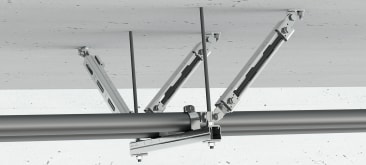
Considering support systems.
The behavior of nonstructural elements and structures during an earthquake is very complex. For this reason, the scientific community has adopted simplified measures for the seismic design of nonstructural elements installed within buildings. This article, explains some crucial aspects of seismic design of nonstructural elements. Simplifications In seismic design, structures are often simplified with one-degree-of-freedom oscillators that resemble inverted pendulums (Fig.1). The wave motions of these oscillators can be calibrated to simulate the actual oscillations of a structure. This calibration makes it possible to model, in a simplified way, the structural behavior and thus facilitates the understanding of the seismic behavior of a structure.
Figure 1. Example of how a structure (left) is simplified with an equivalent simple oscillator (right).
A number of considerations can be made that are useful both for understanding how an oscillator can be calibrated and for learning more about the behavior of a structure during an earthquake. If we shake an oscillator it will take a certain time (called a period and called T1) to complete one full oscillation (return to the point from which it started). Based on common experiences, few things can be inferred regarding the period of oscillation (Fig. 2):
- For the same mass (M) and cross section (S), with an increase in the length L of the oscillator, longer oscillation periods can be expected (and vice versa);
- At the same mass and length (L), with a decrease in the size of the section S of the rod, longer oscillation periods (and vice versa);
- For the same length and cross section, with an increase in the mass of the oscillator we get longer oscillation periods (and vice versa).
If we analyse the above, we could see that when we decrease the oscillator's stiffness k (by increasing L or decreasing the cross-section S) we lengthen its period of oscillation, and similarly, by increasing the oscillator's mass M we lengthen its period. So, it is empirically inferred that the mass M and stiffness k of the oscillator identify and influence its period T1.
Thus, there is a formulation that allows the calculation of how long it takes the oscillator to complete one oscillation by knowing the mass M and the stiffness of the cantilever k (which is influenced by mechanical characteristics of the cantilever such as material properties, length and cross section). Therefore, it is possible to simulate the behavior of structures with an appropriately calibrated oscillator that is then used as a simplification to study structural behavior during an earthquake.
Figure 2. How length L, cross section S and mass M affect the period T of an oscillator.
How an earthquake is studied
Oscillators are used to study the behaviour of structures in earthquakes. To do this, many recordings of historical earthquakes typical of the study area are collected. Oscillators having different oscillation periods from each other are then activated with actions replicating these historical earthquakes. By recording the response of each oscillator, it is therefore possible to create a graph (called demand spectrum) that is a very useful tool to perform the seismic design of structures. In fact, to evaluate the seismic action acting on a building, it is therefore sufficient to calculate the action on the corresponding oscillator as shown in Figure 3.
Figure 3. The image shows a response spectrum assuming a random location in Italy. In the image, it is also possible to see three oscillators representing three structures with low (T1=0.1s), medium (T1=0.5s) and long (T1=2.0s) oscillation periods. The seismic action must be considered in the design of a structure. It is determined by entering the period of the building into the response spectrum.
What about nonstructural elements?
As with earthquakes and structures, nonstructural elements can also be simplified with oscillators. Therefore, a nonstructural element has its own period of oscillation that is named Ta and, as with structures, the period of oscillation of nonstructural elements Ta is influenced by their stiffness and mass.
Usually, nonstructural elements do not directly “feel” the seismic stress because they are anchored somewhere in the structure that filters and modifies the seismic action itself. Therefore, the seismic action acting on a nonstructural element is not the seismic action acting on the structure, and to design it correctly it is necessary to consider the element itself, the characteristics of the earthquake and the characteristics of the structure on which the nonstructural element will be installed.
Influence of the earthquake
Depending on the geographical location being considered, there are two main variables that influence the earthquake.
The first is the intensity (or magnitude). It is rather well known that there are areas of low seismic intensity (implying “less strong” earthquakes) and areas of high seismic intensity.
The second is frequency. In some areas earthquakes cause very rapid ground shaking while in other areas the shaking is slower (even with the same intensity).
Figure 4. Image emphasising how nonstructural elements behave as oscillators connected to the structure.
Influence of height
Equal nonstructural elements behave differently depending on the floor where they are installed because at higher floors they may be subjected to much greater displacements and/or accelerations.
The influence of structure and nonstructural element
The importance of knowing T1 and Ta turns out to be crucial because there is a very interesting phenomenon, called resonance. This phenomenon is similar to when you push a swing, if you do not synchronise the thrust with the movement of the swing, you do not increase the amplitude of the oscillations and indeed might even reduce them. On the contrary, when the thrust is synchronised with the swings the amplitude of the swings increases more and more. This phenomenon is known as resonance and is an effect that you want to avoid during an earthquake.
Suppose we have three nonstructural elements having oscillation periods Ta1=0.5 s; Ta2=1.0 s and Ta3=2.0 s installed in an industrial structure having oscillation period T1=1.0 s (Fig. 5). When the structure is stressed by an earthquake, even one of low intensity, its main vibration mode will have an oscillation period of 1 second. Since the structure has motions with a period of 1 second, the nonstructural elements anchored to it will experience actions with a period of T1=1.0 s. Elements with proper period of vibration (Ta) farther from this value are stressed relatively little, but structural elements with Ta similar to T1 will be stressed greatly precisely because of resonance. The nonstructural element with Ta2=1.0s is stressed much more than the others precisely because its oscillations are synchronised with those of the structure. The other nonstructural elements are accelerated with the wrong synchrony and the oscillation does not increase substantially.
Technical Standards.
The Technical Standards give a rather high level of detail regarding the obligations and how to design nonstructural elements. The goal of the standards is to prevent both economic loss and, more importantly, loss of life. Indeed, nonstructural elements that are not seismically designed can be damaged during an earthquake, obstruct exit routes, render the structure nonfunctional for a long period, injure people due to fall or movement, ...
Figure 5. The illustration shows how an industrial structure and its nonstructural elements are simplified to perform a structural analysis. It is visible how the nonstructural element in resonance with the structure (Ta=T1) is most stressed during an earthquake.
There are formulations (also given in the Technical Standards) for estimating the seismic action that will act on a nonstructural element. Just as reviewed above, the action on the nonstructural element is estimated by considering:
- The seismic action that could act on the structure;
- The height of the building and the height where the nonstructural element is installed (is it located on the roof or on the second floor?) to take into account the influence of the building height;
- The fundamental period of oscillation Ta of the nonstructural element;
- The fundamental period T1 of the structure to consider any resonance phenomena.
It is important to note that, among these four factors, only the period Ta of the nonstructural element can be directly influenced. The other factors are fixed or can be influenced only during the design of the structure itself, which usually takes place long before the design of the nonstructural elements.
Given the legislative obligations and the significance of the nonstructural elements, it is important that they be properly seismically designed.
Figure 6: Three examples of seismic design (according to Eurocode EC and according to NTC technical standards) considering Ta=0 sec, Ta=T1 (resonance) and with calculation of actual Ta. In the example, the non-structural element considered in resonance (Ta=T1) will be with a higher seismic action (+25% EC, +30% NTC) than a designed element considered its own Ta. Similarly, designing a nonstructural element assuming Ta=0 results in an underestimate (-30 EC, -75% NTC) of the seismic action.
The importance of evaluating Ta
As anticipated, of the various factors that influence the seismic action on a nonstructural element (previous list) the fundamental period Ta turns out to be the least trivial factor to evaluate and also the only one that can be influenced during the design of the nonstructural element itself. Its proper evaluation and design can lead to great benefits because the seismic action on the nonstructural element could be limited or very large. Given the difficulty of assessing Ta one of the following simplifications are often assumed.
- Ta=T1 - Non-structural element assumed to resonate with the structure. This assumption leads in many cases to an overestimation of the seismic action. In the example in Figure 6, design in resonance leads to an overestimation of the seismic action of +25% compared to a design with real Ta. In fact, in these cases it is possible that the design is very pro-safety but at a very limited optimisation solution. Therefore, there will be excess material, possible increase in construction time, increase in cost, increase in environmental impact (CO2), ...
- Ta=0sec - Non-structural element assumed to be infinitely rigid. This assumption is in many cases to the detriment of safety because it implies an underestimation of seismic action. In the example in Figure 6, the design with Ta=0 leads to an underestimation of the seismic action by -30% compared to a design with real Ta. In these cases, the design is unsafe because both resonance effects and the influence the structure has on the element itself are neglected. The risks of this type of design are considerable and could even be fatal to the protection of both the non-structural element and people.
To learn more and to get design advice on specific projects, you can contact our experts - teamengineering.sg@hilti.com
