
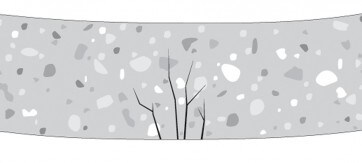
Concrete cracks when tensile stresses induced by loads or restraint conditions exceed its tensile strength.
Concrete cracks when tensile stresses in the concrete imposed by loads or restraint conditions exceed its tensile strength. Concrete is typically assumed to crack under normal service load conditions. Crack width and distribution are generally controlled through the use of reinforcement. The existence of cracks in the anchor vicinity can result in a reduced ultimate load capacity and increased displacement at ultimate load compared to uncracked concrete.
ACI 318 and IBC building codes assume cracked concrete as the baseline condition for design of cast-in-place and post-installed anchors. Crack width and distribution are generally controlled through the use of reinforcement. With consideration for the protection of the reinforcing steel, crack widths, per ACI 318 are assumed to be less than approximately 0.02” (0.5 mm) for seismic loading and approximately 0.012” (0.3 mm) for other cases.
Concrete cracks develop from internal tensile stresses induced by external forces, volumetric changes and creep.

These cracks can have a negative effect on the performance of cast-in-place and post-installed anchors. The cracks can cause a reduction in the ultimate load the anchor can resist and an increase in the amount of displacement the anchor undergoes at ultimate load.

Design for uncracked concrete conditions is permitted by the model Building Codes only for cases where it can be shown that cracking of the concrete at service load levels will not occur over the anchor service life. For cases involving design for seismic actions, ACI 318 require post-installed anchors to be tested for use in cracked concrete as well as for seismic loading.
To assist you in designing for cracked or uncracked conditions, Hilti offers best-in-class design software, PROFIS Engineering. Hilti PROFIS Engineering is comprehensive design software for anchor design in concrete and includes a versatile load engine and various options for base plate analysis. PROFIS Engineering includes the Anchoring to Concrete provisions of the ACI 318 Building Code and the ACI 349 Nuclear Code.
Included within PROFIS Engineering software are a number of powerful features, exclusive to Hilti, that greatly enhance the user's choice and efficiency. Users can design with Hilti mechanical and adhesive anchor systems as well as cast-in-place headed studs and headed bolts. You can find here tutorials explain how to navigate within PROFIS Engineering.
