
How to determine fire performance
Fire is certainly a clear danger to any construction and needs to be prevented as a fire may occur anywhere and at any phase over the lifetime of a building, whether during construction or during service.
Insurance can compensate for the material damage caused by a fire, but it cannot protect against severe and irreparable consequences, such as loss of life or health or damage to the environment.
To increase fire protection and limit the spread of fire, ensuring evacuation routes and exits, the building should be divided into smaller fire sections by using fire-resistant elements, such as floor, walls, etc, (Figure 1).
When post-installed reinforcing bar connections are part of a fire-rated assembly (floor, roof, etc.), it is important that the fire resistance of the connection is evaluated using test data for the time-dependent reduction in bond strength associated with typical geometries and time-temperature loading protocols.
In general, these elements are designed and constructed to provide a specific period of fire load-bearing capacity resistance (R), typically rated for 30, 60, 90, 120, 180 or 240 minutes.


Figure 1: example of fire compartmentation
The post-installed connections involved in fire can be divided into two types:
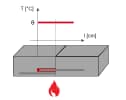
- Overlapping splices, such as slab-to-slab connections, where the surface is exposed to fire and the temperature along the anchorage length is constant and a function of the concrete cover and duration of fire (Figure 2).
- Intersections, such as simply supported slab-to-wall connections, where the surface of the existing element and that of the new element is exposed and the temperature along the anchorage length is not constant (Figure 3).

Figure 2: Typical temperature distribution of overlapping splices connections under fire

Figure 3: Typical temperature distribution of intersection connections under fire
Fire qualification
The qualification of post-installed rebar connections in fire conditions is covered by the European Assessment Document EAD 330087, which is issued by EOTA and allows a design according to Eurocode 2. The assessment focuses on the bond strength behavior of the mortar in relation to temperature. The outcome of the assessment reflected in the European Technical Assessment is given in terms of temperature reduction factor kfi (θ) and is used to calculate fbd,fi for equation 3.8 of Eurocode 2, part 1 EN 1992-1-1.
The reduction factor kfi (θ) for the bond strength is derived through testing under simulated fire conditions. A constant load is applied to the rebar in a confined setup, while the temperature of the concrete specimen is increased according to a predefined heating rate. The temperature values are continuously measured in the borehole by means of two thermocouples. The temperature is increased until failure of the tested sample. With a minimum number of n=20 tested samples, and data points distributed in stress intervals smaller than 1 N/mm2, a fitting curve for the data set of tensile bond strength as a function of the weighted average measured temperatures at failure is assessed. This curve is then translated into the reduction factor kfi (θ) by calculating the ratio of the bond strength values to the reference value for cast-in-rebar for the respective concrete class. 
Figure 3. Example of the graph of reduction factor kfi (θ) for concrete strength class C20/25, from EAD 330087
Some additional requirements are introduced in the latest version of EAD 330087 for the test series described above. These account for the particular behavior of cement-based mortars. For such systems, a lower sensitivity to fire conditions is expected in comparison with resin-based systems. Therefore, the qualification procedure considers the particular possibility that failure does not occur at fire-relevant temperatures and under certain applied loads.
The requirements for the testing protocol are thus adjusted in case this situation occurs or failure is not observed. The potential run out load level is confirmed with a total of three repetitions and the tests at lower loads may be omitted.
In addition, for mortars exhibiting a limited reduction in strength over temperature (e.g. cement-based mortars) it must be ensured that the assessed fire performance given in the ETA is limited to the cast-in rebar performance under fire, as given in Eurocode 2.

